
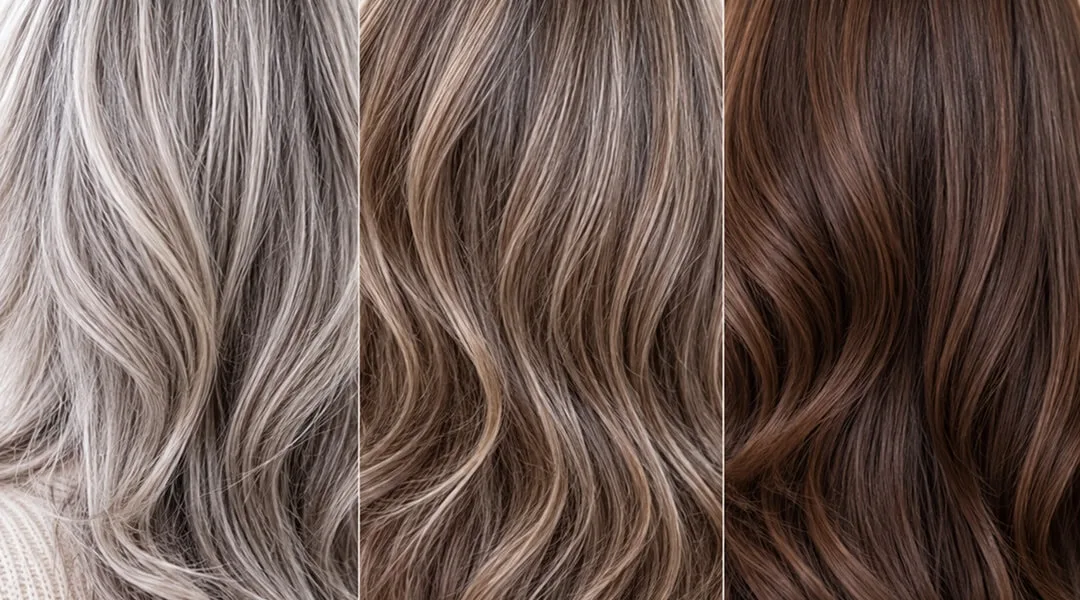
Grey hair coverage raises a specific question. Do you want opaque coverage, sheer coverage, or grey blended into a multidimensional colour?
The answer changes depending on whether your grey is concentrated in one area or spread across your whole head. Would you rather let your grey hair show gradually? Our guide on the transition to grey hair covers that approach.
Finding the best way to cover grey hair in your case doesn't mean finding the most opaque formula. It means finding the one that matches the level of coverage you want and the real condition of your hair fibre.
This is what the Blonnoir team, a hair colour salon in Saint-Lambert, assesses with you before choosing your coverage.
White hair and grey hair, why does distribution matter?
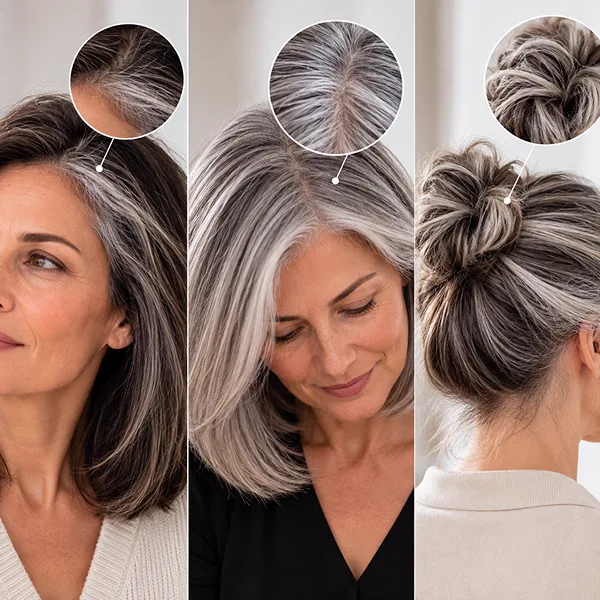
So-called grey hair often mixes strands that still have pigment with strands that no longer do. The overall look depends on their proportion and how they are spread.
A white area concentrated at the temples doesn't react like a few scattered strands, and this distribution directly shapes the technique best suited to you.
How can you cover grey hair without a sudden change?
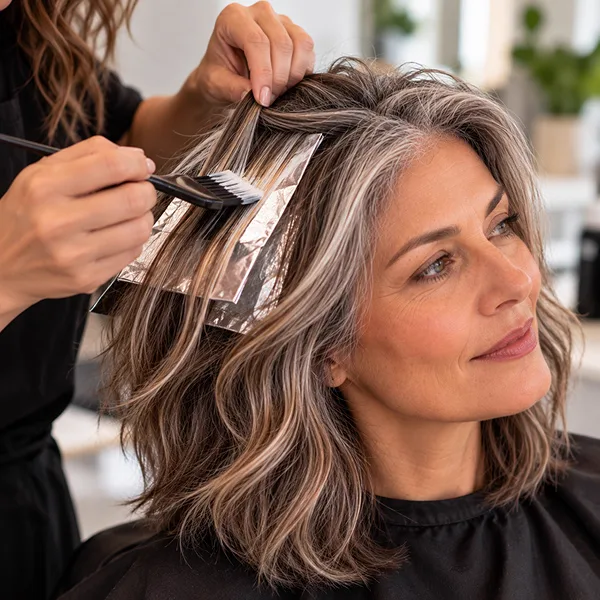
Many people mainly want to avoid a change that is too noticeable. Going from white regrowth to full coverage overnight can look artificial, even with good technique.
A gradual approach helps avoid this effect. Rather than aiming for full coverage at the first visit, some people prefer to start with the most visible areas, around the face or on top, before extending coverage to the rest of the hair over several appointments.
The choice of shade also matters a great deal in how natural the result looks. A colour slightly lighter than your original base usually creates a softer transition than a very dark shade, which sharpens the contrast from the first regrowth.
Finally, how often you get touch-ups directly affects how long the result stays believable. Spacing appointments too far apart after strong coverage can bring back a sharp line of demarcation.
Which levels of coverage can you consider?
| Desired level | Overall look | Upkeep to plan for |
|---|---|---|
| Full coverage | Uniform colour | Regrowth more visible if contrast is high, touch-up about every 3 to 5 weeks |
| Soft coverage | Variations still visible | More flexible evolution, about every 6 to 8 weeks |
| Luminous blending | White mixed with lighter areas | Tone follow-up needed, root highlights about every 3 months |
| Embraced white | Natural pigment kept | Care suited to shine |
These are approximate guidelines, since every regrowth moves at its own pace and the shade difference and desired effect can change them.
Why does some grey hair resist colour?
Texture, porosity and history all influence how colour takes. Some grey hair seems coarser or drier.
If your lengths already show bands or built-up pigment, don't automatically layer a new shade on top. The guide on colour correction explains why.
This is exactly what the 30-minute consultation at the Saint-Lambert salon helps check before you decide.
This assessment looks at the condition of the fibre and any buildup, information that neither a photo nor a memory of your last colour can give as precisely.
Health Canada recommends repeating the skin allergy test before every permanent or semi-permanent application, even after several uses.
What mistakes should you avoid when colouring grey hair?
A common trap is choosing a shade that is too dark compared to your natural regrowth, hoping to delay touch-ups. The resulting contrast is often stronger, not weaker.
Concentrated white areas, like the temples or the part, pose a different problem. A uniform formula applied to the whole head often overlooks that these areas need a different processing time or application.
Regularly switching brands or types of colour without telling your colourist also makes follow-up harder, since results vary from one visit to the next without a clear reason. Keeping track of what has been used helps achieve more predictable coverage over time.
What do people ask about grey hair coverage?
Is partial coverage possible on very white temples?
Yes, especially with luminous blending, but it depends on how concentrated the white really is in that area.
Does colouring grey hair need more upkeep?
Usually yes for full coverage, because the contrast at the regrowth becomes more visible.
Can you switch from full coverage to embraced white?
It's possible, but gradually. A planned transition limits sharp lines.
How long before white regrowth shows again?
It depends on the level of coverage chosen. Full coverage usually shows regrowth sooner than luminous blending.
Why have your coverage assessed in Saint-Lambert?
To cover grey hair, Blonnoir offers regrowth colour, roots and lengths colour, toner, and balayage and toner among its colour services. The salon welcomes clients from Saint-Lambert and the surrounding area, on Montreal's South Shore.
The most useful starting point is showing your natural regrowth and saying clearly how much sheerness you accept, rather than starting from a reference photo of someone else. The same photo can give a very different result from one person to another.
You already know you want to cover, now it's about how. Book online to have your regrowth assessed and choose the right level of coverage.