

A haircut photo never shows how that hair behaves in the morning, without a stylist. Yet that version, without a professional blow-dry, should guide your choice, more than any list of the best haircut for face shape.
Why start with texture rather than face shape?
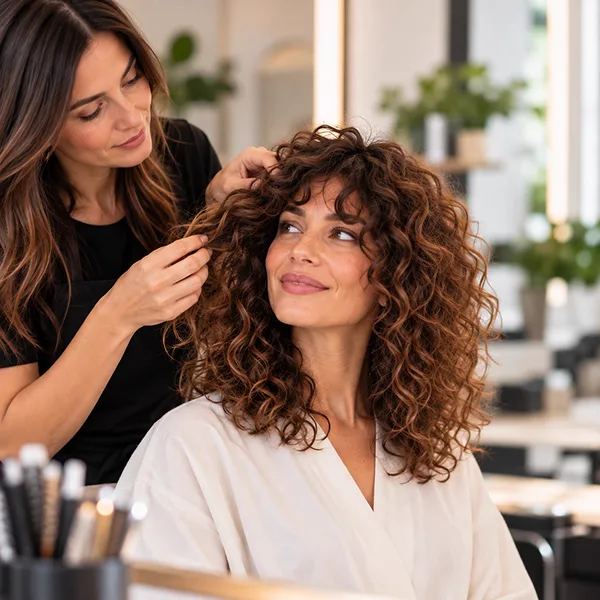
Texture shows how a cut will move or shrink as it dries. Straight hair clearly reveals lines. Wavy, curly or textured hair creates its own volume.
What is the best haircut for your face shape?
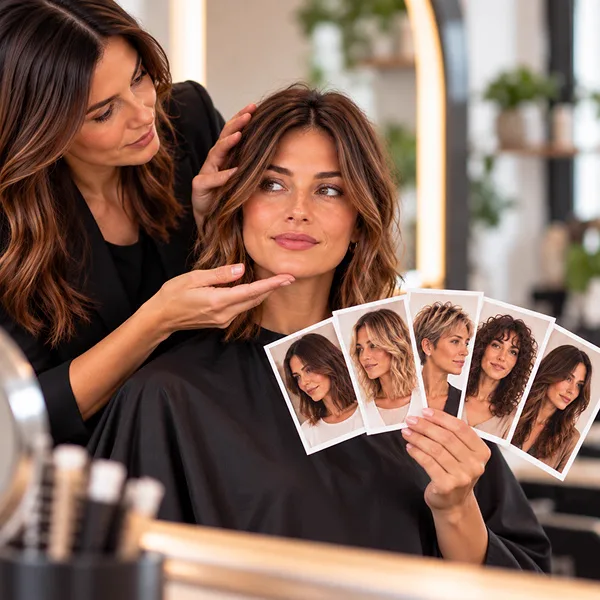
Face shape comes up often when people search for a new cut, and for good reason. It gives useful guidelines, even though it should never become a rigid rule that rules out a style you love.
A longer face can be balanced by a cut that adds visual width, like a bob or layers around the cheeks.
A rounder face often benefits from a length that falls below the chin to visually lengthen the features, while a more angular face can be softened by less defined lines or layered bangs.
These guidelines remain general. Texture, density and the way your hair naturally moves can completely change the result of a cut that is, in theory, right for your face.
That's why face shape is a starting point for the conversation with your stylist, not the final answer.
Which length fits your routine?
A short cut doesn't always mean low maintenance. Some lines need precise styling, while enough length lets you tie your hair back on busy days.
| Habit | What to preserve | Useful question |
|---|---|---|
| Air drying | Natural movement of the texture | Where does the volume form? |
| Frequent blow-drying | A line that is easy to style | How much time can you give to styling? |
| Hair tied back | Enough length | Which strands need to stay in place? |
| Low maintenance | A shape that holds day to day | What result can you accept without tools? |
After 40, is it about texture or age?
The question of length after 40 comes up often, but it has no universal answer. What really changes over time is sometimes texture, with hair that loses density or, on the contrary, gains more volume than before.
A length that suited you ten years ago may need more upkeep today if your texture has changed.
The best approach is to observe how your hair behaves now, not how it used to behave, and adjust the cut to that reality rather than to a number.
How do you add volume without weighing hair down?
On fine hair, removing too much bulk reduces the feeling of density. A fuller line visually strengthens the ends. On thick hair, the work focuses more on how volume is distributed than on how much there is.
The American Academy of Dermatology recommends limiting heat and letting hair partly air dry before styling. Its tips for styling without damage fit well with this thinking about your routine.
Tell your stylist how much time you really spend styling in the morning. It's often what separates a good cut from one that doesn't survive daily life.
The articles from Blonnoir on 2021 colour and haircut trends and 2020 trends offer visual ideas without dictating a choice.
What questions come up before a new haircut?
Which haircut needs the least daily upkeep?
Low maintenance haircuts usually follow your natural texture. They need less styling than a line that forces hair into a shape that goes against its movement.
Which haircut suits fine hair that lacks volume?
Light layers and a fuller line at the ends often help keep a feeling of density without weighing the hair down.
Can you completely change your cut without risking disappointment?
A big change is easier to plan by first discussing your references, the limits of your texture and your real routine.
Should you bring a specific photo or just a general idea?
Both help. A photo shows a direction, but explaining what your hair refuses to do helps your stylist even more.
How do you book your personalized haircut in Saint-Lambert?
Blonnoir's women's cut and style service lets you shape the cut, then see the finish in both versions, styled and natural.
During the consultation, the stylist considers your density, growth pattern, natural texture, home routine, styling time and the result you want.
Three priorities to clarify before booking are your minimum length, the styling time you accept and the area where you want movement.
These details, more than the name of a trendy cut, decide whether the result will hold up day to day.
A good haircut starts with a good conversation. Book your cut at Blonnoir and come with your real morning habits, not just a photo.